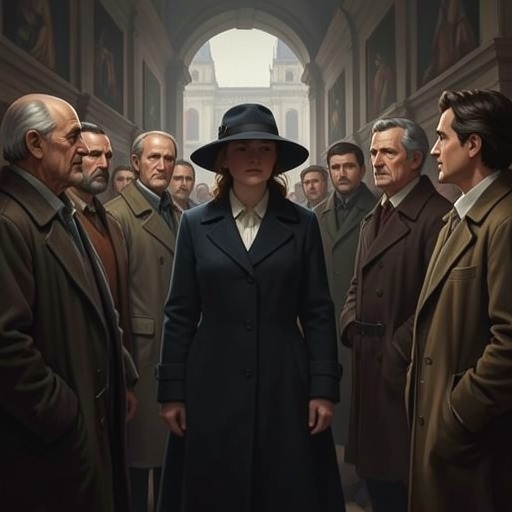
Johanna Meyer
The Collini CaseJohanna Meyer is Hans Meyer’s granddaughter and Philipp’s sister, but her place in the story cannot be reduced to either family tie: she is also Caspar Leinen’s former lover and a continuing presence in his life. When Leinen agrees to defend the man accused of killing Hans Meyer, Johanna confronts him with the personal cost of that decision. Later, as the trial brings the family’s history into public view, she remains close to its consequences while the story leaves open what that history means for her own identity.
Identity and Background
Johanna is part of the Meyer family, whose standing is apparent in the company’s Munich offices and its arrangements for guests. Her grandfather, Hans Meyer, had been a familiar presence in Leinen’s childhood: Leinen remembers waiting for him at the oval walnut table in the company’s conference room. In the present, Johanna occupies the chair where Hans used to sit. The reversal makes family history tangible in a room Leinen knows from long before the murder trial.
Johanna’s own adult life has taken her beyond that childhood setting. Four years after Philipp’s death, she married an Englishman twenty years older than she was, a kindly man who had been her professor at Trinity College, Cambridge. At the wedding, she whispered to Leinen that she missed Philipp and touched his cheek. Leinen held her arm and kissed her palm; for a moment, he thought their relationship might still be saved. That possibility belongs to his perception, not to any promise Johanna makes, and the scene leaves their shared grief at the center of their brief closeness.
Her Relationship with Caspar Leinen
The history between Johanna and Leinen gives their later conflict its force. They have known one another since childhood, and Philipp’s death is part of the grief they share. After the funeral, Leinen returned to Rossthal only once before the wedding. When he calls Johanna six years after it, she answers at once. She says she has been trying to reach him since the previous day and asks why he is doing this. Her urgency suggests that the decision has become immediate and personal for her, not simply a professional matter happening at a distance.
Johanna identifies the decision plainly: Leinen is to act as defence counsel for her grandfather’s murderer. Her words expose the collision between his role as a lawyer and his place in her family’s life. Leinen has not merely taken on a difficult case; he is defending the accused in a killing that has struck someone with whom he shares a past. Johanna’s call makes that conflict explicit before they meet in person.
The Meyer Company and the Murder Case
Two days after the murder charge reaches Leinen’s chambers, Johanna calls again, sounding strange, and asks him to come to Munich. He drives there from Berlin in the old Mercedes his father gave him. They meet at the Munich branch of Meyer Engineering Works, in a conference room he remembers from childhood. Johanna sits where Hans once sat, but the familiarity of the room cannot make the meeting easy: she is grave and does not look at Leinen, and no one touches the biscuits set out on porcelain plates.
A company lawyer joins them, but the meeting yields no explanation of the connection between the firm and the accused, Fabrizio Collini. After looking through its archives, the lawyer says the company has found nothing—not even an invoice to or from anyone named Collini. His knowledge is limited, and the meeting offers no answer to the questions around the case. Johanna is present as the family’s representative in a practical sense, but the scene does not give her a solution or a clear account of what Hans’s business records might reveal.
At the Trial
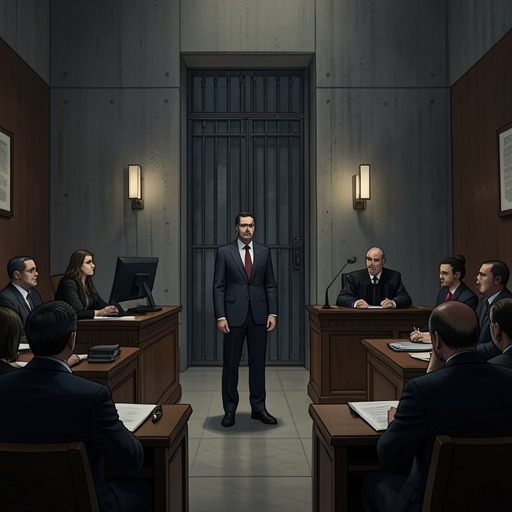
Johanna later sits rigidly on the accessory prosecution team’s bench, facing Leinen. At the end of that day in court, she is pale and looks at him as if she has never seen him before. She whispers that he should get her out of there. Leinen leads her away from the main entrance, through the long corridors and down to the multi-storey car park, avoiding the journalists waiting outside. The old Mercedes does not start on the first attempt. The small delay extends a departure that is already a retreat from public view, and shows Leinen responding to her immediate request despite their opposing positions in court.
Johanna also acts decisively when she learns that the company lawyer, Holger Baumann, tried to bribe Leinen. Mattinger tells Leinen that Johanna fired Baumann the previous day and was outraged by the attempted bribe. The account comes from Mattinger rather than from Johanna herself, but it establishes the consequence: she does not protect the company lawyer once his conduct is revealed. Her family connection to the firm does not prevent her from dismissing him.
Identity and Ending
After leaving the courthouse, Leinen finds Johanna sitting on the steps outside his building. She asks whether she is all those things too, and he answers that she is who she is. The scene gives no precise list of what she means by “those things”; the uncertainty matters. After the trial has forced the family’s history into view, Johanna’s question turns from what Leinen is doing for her grandfather to how that history bears on her own self-understanding. His reply offers recognition rather than a verdict.
The exchange is quiet and unresolved. Johanna does not explain the question further, and the story does not settle what answer she will make for herself. Her final presence beside Leinen recalls their earlier intimacy, but it does not erase the conflict that brought them apart: she belongs to the family at the center of the case, while he has undertaken the defence. Through Johanna, the novel keeps that conflict personal without pretending that affection can supply a simple judgment about the past.